



Last updated: October 1, 2026. We update this guide every week through October as color reports come in.
Blue Ridge Parkway fall colors turn 469 miles of mountain road into the best leaf-peeping drive in the East. Every October, the ridges shift from green to red, orange, and gold, and the overlooks fill with drivers chasing peak color.
It is the one month when the parkway truly lives up to its name, with color wrapping every curve.
The trick is timing. Color does not peak everywhere at once.
It starts at the highest elevations in early October and moves downhill for weeks, so the right week depends on which section you drive.
This guide gives you:
- The typical peak-week pattern by elevation and milepost
- The 15 best overlooks for fall color
- A foliage map strategy
- Practical tips for an October trip
Blue Ridge Parkway Fall Colors at a Glance
Takeaway: Blue Ridge Parkway fall colors usually peak from early to late October, starting at the highest elevations and moving down.
- The highest peaks (above 5,000 feet) peak first, in early to mid-October
- Mid-elevation sections follow in mid to late October
- The low valleys finish in late October to early November
- Plan around the third week of October for classic Blue Ridge Parkway fall foliage
- Pick your mileposts by elevation
Blue Ridge Parkway Fall Color Peak Week by Section
There is no single peak week for the whole parkway. The road climbs from river valleys to 6,000-foot peaks, and each elevation band turns at its own pace.
Cold air settles on the high ridges first, so color starts up top and works its way down over three to four weeks.
The table below shows the typical pattern by elevation. Treat it as a general guide, not a forecast. Weather shifts the schedule every year, so check the weekly color reports (linked below) before you lock in dates.
| Elevation | Example mileposts | Typical peak window | What to expect |
|---|---|---|---|
| Above 5,000 ft | MP 355 to 365 (Mount Mitchell, Craggy Gardens); MP 430 to 451 (Cowee Mountain, Waterrock Knob) | Early to mid-October | First color of the season. High ridges flame red and orange while valleys below are still green. |
| 4,000 to 5,000 ft | MP 294 to 316 (High Country: Rough Ridge, Linn Cove Viaduct, Grandfather Mountain, Linville Falls) | Mid-October | The classic postcard week. Dense color on every ridge, with the viaduct and Rough Ridge at their best. |
| 3,000 to 4,000 ft | MP 176 to 240 (Mabry Mill, Doughton Park); MP 384 to 412 (Asheville area) | Mid to late October | Rolling color across meadows and mid-slope forests. Great for photography with softer light. |
| Below 3,000 ft | MP 0 to 120 (Rockfish Gap to Roanoke, James River valley) | Late October to early November | The last color of the season. Golden valleys and quiet roads after the October crowds thin out. |
The single best strategy is to chase elevation, not dates.
If you arrive in the first week of October, head for the highest mileposts. If you can only travel in the last week, the valleys and lower overlooks will still be glowing.
Why does elevation matter so much? Fall color starts when cool nights break down the green chlorophyll in leaves and reveal the reds, oranges, and golds underneath.
Cold air sinks onto the high ridges first, so the sugar maples and red oaks up top turn weeks before the hickories and poplars in the valleys.
That is why Blue Ridge Parkway fall colors roll downhill like a slow wave every October, and why a 2,000-foot change in elevation can mean a two-week change in timing.
For the freshest information, check the weekly fall color reports from Blue Ridge Parkway Association and the national foliage prediction maps each September. They track real-time color by region, which beats any fixed calendar.
Fall Foliage Map: Where Color Peaks First
A fall foliage map shows you where color is peaking right now, which matters more than any date on a calendar.
The national prediction maps shade the country from green (no change) through yellow and orange to deep red (peak), and they update through the season.
Read the map by elevation, not by north and south. The highest ridges of the parkway, around Mount Mitchell and the southern high country near Waterrock Knob, always turn first.
The map will show deep color there while the Virginia section and the river valleys still read green or yellow.
One more thing the maps will not tell you: peak is a window, not a day. When a report calls a section peak, the best color usually holds for about a week, sometimes longer if the weather stays calm.
Wind and heavy rain strip leaves fast, so a calm, dry week after peak can be just as beautiful as peak itself.
Use the map together with the elevation table above:
- Find the band that is peaking this week
- Pick overlooks in that milepost range
That simple two-step move puts you in the best color on any October day.
Weekly color reports usually start in mid-September and run through the end of October. Check them the week you travel, since a warm September can push peak back by several days and an early cold snap can pull it forward.
We refresh the timing guidance in this Blue Ridge Parkway fall foliage guide every week through October so the advice stays current.
Check Road Closures Before You Drive
Some parkway sections close without much warning. Storm damage, rock slides, and maintenance work can shut down stretches of road, and a closure can cut off the exact overlooks you planned to visit.
Check the NPS road closures page the morning you leave, and again if you are driving multiple days. The page lists every closed section by milepost, so you can reroute around it.
In October, closures at high elevations can also appear after early cold snaps, so build a backup plan with lower-elevation stops.
Recovery work from past storms is still ongoing in places along the parkway, which means some sections may have one-lane traffic or short detours. These change through the season, so the NPS page is the only source worth trusting.
If your must-see overlook sits inside a closed section, pick the nearest open overlook at a similar elevation. The color will be just as good.
15 Best Overlooks for Fall Color
These are the best overlooks for Blue Ridge Parkway fall colors, listed north to south. Each entry gives the milepost, the elevation where it matters, and the best time of day.
Pair this list with the peak-week table above: visit the high-elevation stops early in the month and the lower ones later.
A quick photography tip before the list: the richest color photographs come in the first and last hour of daylight, when low sun saturates the reds and golds.
Overcast days work well too, since soft light brings out color without harsh shadows.
- Humpback Rocks (MP 6). Morning. A rocky summit above the Rockfish Valley with wide views of early-turning lower slopes. It peaks later than the high country, so it is a good late-October stop.
- Peaks of Otter (MP 86). Morning. Abbott Lake mirrors the red and gold hillsides on calm days. Arrive early for glassy water and the best reflections.
- Mabry Mill (MP 176). Morning. The most photographed mill on the parkway, framed by maples that turn brilliant red. The pond doubles the color.
- Doughton Park (MP 238.5). Late afternoon. Rolling meadows and old cabins sit above a deep valley of color. The low sun lights up the whole basin.
- Moses H. Cone Memorial Park (MP 294). Morning. The manor house lawns and carriage trails wind through hardwoods at their mid-October peak. An easy, crowd-friendly stop.
- Price Lake (MP 297). Morning. Still water, colorful shoreline, and Grandfather Mountain rising behind it. One of the best reflection shots on the parkway.
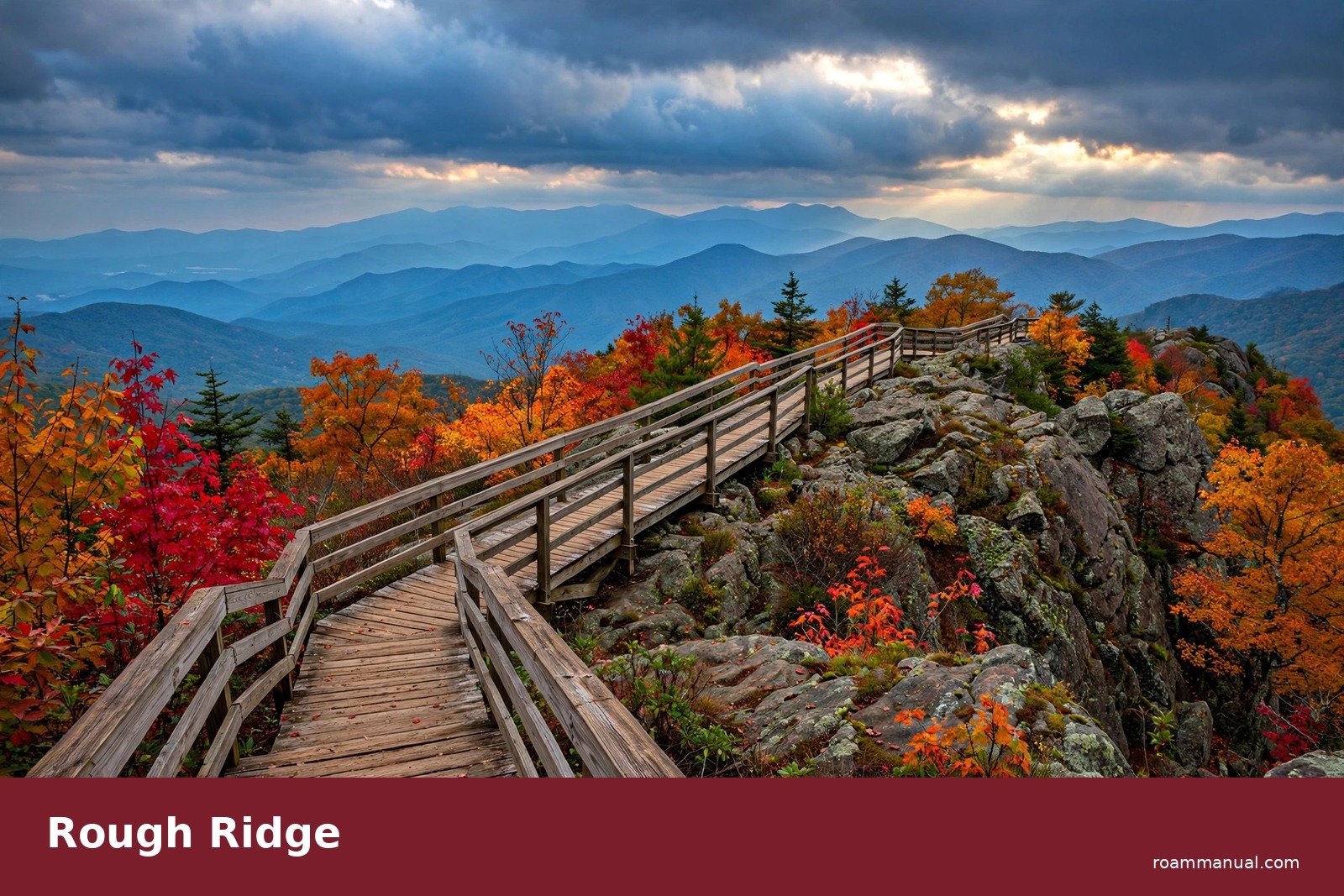
- Rough Ridge (MP 302.8, summit 4,773 ft). Sunset. The boardwalk trail climbs to 360-degree views of flaming ridges. This is the single most popular fall color hike on the parkway, so arrive at least an hour before sunset for parking.
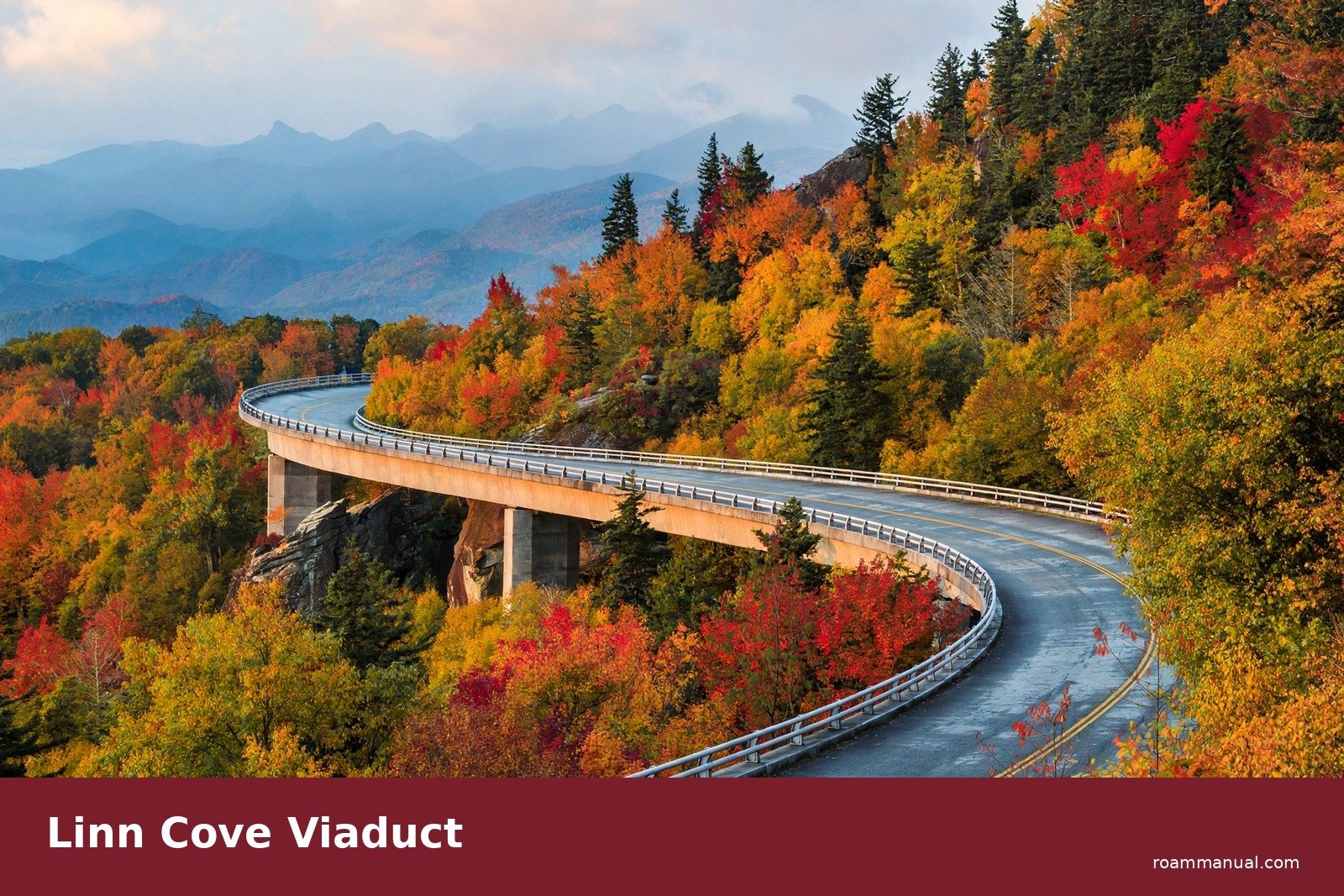
- Linn Cove Viaduct viewpoint (MP 304, bridge at 4,100 ft). Sunrise. Watch first light hit the famous S-curve bridge with Grandfather Mountain glowing behind it. The viewing area below the bridge beats the drive-by view.
- Beacon Heights (MP 305.2). Either. A short walk to two rock viewpoints facing different directions. It is the easiest big color payoff on the parkway and rarely as crowded as Rough Ridge.
- Grandfather Mountain (MP 305, detour). Morning. At nearly 6,000 feet, this is one of the first places to turn each fall. The mile-high swinging bridge gives you color in every direction. Note the entry fee.
- Linville Falls (MP 316). Midday. The gorge drops away beneath overlooks ringed with color. Midday sun reaches into the canyon and lights up the falls.
- Mount Mitchell (MP 355, detour via NC 128, 6,684 ft). Sunrise or sunset. The highest peak east of the Mississippi turns earliest, often in the first week of October. The observation deck looks across endless colored ridges.
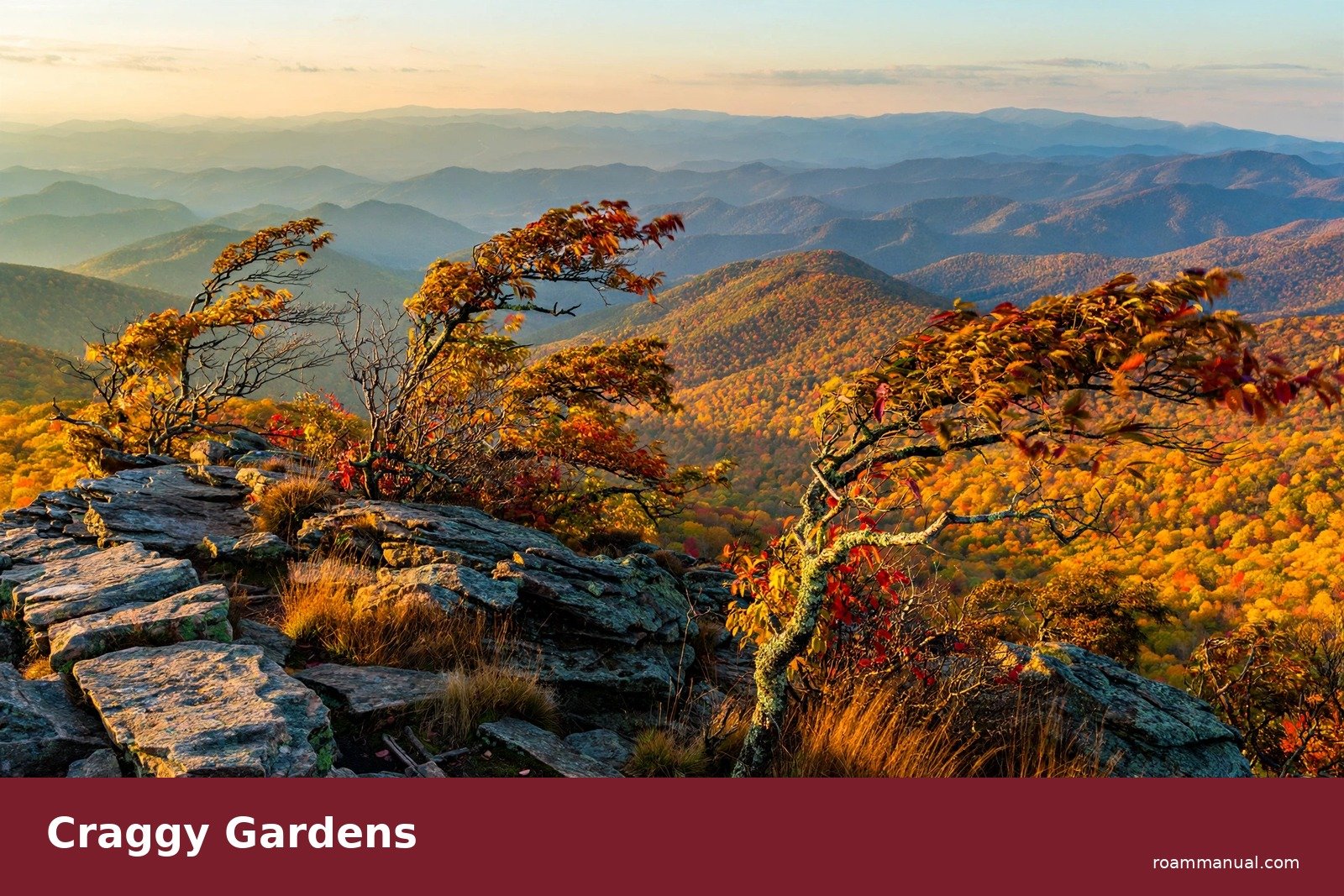
- Craggy Gardens (MP 364, about 5,500 ft; Craggy Pinnacle 5,892 ft). Sunset. Rocky balds and rhododendron tunnels blaze in early to mid-October. The west-facing Pinnacle rocks are made for golden hour.
- Cowee Mountain Overlook (MP 430.7, 5,950 ft). Sunset. A huge southeast-facing panorama of layered ridges near the highest point of the parkway. It peaks early and often sits above a sea of lower color.
- Waterrock Knob (MP 451.2, 6,292 ft). Sunset. Near the southern end, with a 360-degree panorama from one of the highest overlooks on the road. The short summit trail is worth the climb for the full sweep of color.
Takeaway: The best overlooks by time of day:
- Sunrise: Linn Cove Viaduct, Mount Mitchell, or Price Lake
- Sunset: Rough Ridge, Craggy Pinnacle, Cowee Mountain Overlook, or Waterrock Knob
- Sunrise means fewer crowds; sunset means warmer light
- Arrive 20 minutes early and stay 15 minutes after the sun drops
- The best color often comes after sunset
Best Short Fall Hikes
Three short trails give you the most fall color for the least effort. All three sit at high elevation, so they peak early in October.
Each trailhead has its own parking lot right off the parkway, which means you can combine two of them in a single morning if you start early.
Rough Ridge (MP 302.8). About 1.2 miles round trip to 360-degree views from 4,773 feet. The boardwalk section crosses fragile habitat, so stay on the path. Go on a weekday or before 9 a.m. in October.
Beacon Heights (MP 305.2). About 0.6 miles round trip to two rock viewpoints. It is the easiest high-elevation color in the High Country and a good backup when Rough Ridge parking is full.
Craggy Pinnacle (MP 364). About 1.4 miles round trip through rhododendron tunnels to a rocky summit at 5,892 feet. Early October color here is some of the best on the parkway.
Best Day and Time to Visit in October
Weekdays beat weekends by a wide margin. October Saturdays bring the heaviest crowds of the year, with full parking lots at Rough Ridge, Craggy Gardens, and the viaduct viewpoints by mid-morning.
If you must visit on a weekend, start before 9 a.m.
- Early morning: empty overlooks, calm air for reflections, and soft light
- Late afternoon: works too, but the popular sunset spots fill up fast
- Midday: the quietest-kept secret. The light is harsher for photos, but the trails and overlooks empty out between the morning and sunset rushes
The single most crowded weekend is usually the one around the mid-October holiday, when leaf peepers flood the High Country.
If your dates are flexible, aim for a Tuesday through Thursday trip in the third week of October. You will get peak Blue Ridge Parkway fall foliage with a fraction of the traffic.
Driving Tips for October Weekends
October weekends are the busiest time of the year on the parkway, and a little planning saves hours. Park at popular overlooks before 10 a.m. or after 3 p.m., and skip the midday rush entirely.
Remember the basics:
- The speed limit is 45 mph, and rangers enforce it
- There are no gas stations on the parkway, so fill up in Blowing Rock, Asheville, or Waynesville before you enter
- Food is limited to a few seasonal spots, so pack snacks and water
- Fog can roll in fast at high elevations, so keep headlights on and slow down when visibility drops
Pack for two seasons in one day:
- Layers
- A warm jacket
- Gloves for sunrise stops
October mornings at 5,000 feet can be near freezing while afternoons in the valleys reach the 60s.
- Turn headlights on in the tunnels
- Give cyclists room on the narrow road
- Never stop in the travel lane for photos
- Use the overlook pullouts, even when the color tempts you to brake
Where to Stay for Fall Color
Book lodging as early as you can. October weekends sell out months ahead in the mountain towns, and prices peak with the leaves. Weekday stays are easier to find and cheaper.
Blowing Rock and Boone put you near the High Country color: Rough Ridge, the viaduct, Grandfather Mountain, and Linville Falls. This is the best base for the 4,000 to 5,000-foot band that peaks in mid-October.
Asheville works well for the southern half: Craggy Gardens, Mount Mitchell, Cowee Mountain Overlook, and Waterrock Knob. It also has the most restaurant and hotel choices.
See our best areas to stay in Asheville for first-timers and things to do in Asheville to plan the town side of your trip.
Cabins and vacation rentals near the parkway are another good option, especially for groups. They sit closer to the high-elevation color than most hotels, and a porch with a ridge view beats a parking lot any October morning.
Whatever you choose, book three to six months ahead for October weekends. The towns along the parkway are small, and the best places fill up fast when Blue Ridge Parkway fall colors hit their stride.
For the full drive, pair this guide with our Blue Ridge Parkway road trip itinerary, which covers the whole 469 miles in three days.
And if waterfalls are on your list, our Blue Ridge Parkway Waterfalls guide rounds out the trip.
FAQs
When is peak fall color on the Blue Ridge Parkway?
Peak fall color usually runs from early to late October:
- Highest elevations above 5,000 feet: early to mid-October
- Mid-elevations: mid to late October
- Lowest valleys: late October to early November
What week is best for fall colors in 2026?
The third week of October is the safest bet for the most color across the most mileposts.
High-elevation stops like Mount Mitchell and Craggy Gardens peak earlier, while valleys near Rockfish Gap peak later, so match your week to your elevation.
Where is the best fall foliage on the parkway?
Rough Ridge, the Linn Cove Viaduct, Craggy Gardens, Cowee Mountain Overlook, and Waterrock Knob are the standout spots. Rough Ridge and Craggy Pinnacle give the biggest panoramic payoff for short hikes.
Is October too late or too early for fall color?
Neither, as long as you pick the right elevation. Early October is perfect for the high peaks; late October is perfect for the valleys. Only a trip in the wrong week for the wrong milepost misses the color.
Can I see fall colors from the car?
Yes. The parkway was built for windshield viewing, and almost every mile in October has color. But the overlooks are where the views open up, so stop often.
Is the Blue Ridge Parkway open in fall?
Yes, the parkway is open in fall, though individual sections can close for storms, rock slides, or maintenance. Check the NPS road closures page before you go.
How crowded is the parkway in October?
October weekends are the busiest of the year, with full lots at the popular overlooks by mid-morning. Visit on weekdays, or start before 9 a.m., to avoid the crowds.
If you can only come on a Saturday, drive the southern sections near Waterrock Knob or the Virginia section, which draw fewer leaf peepers than the High Country.
What is the best fall foliage near Asheville?
Craggy Gardens (MP 364) and Mount Mitchell (MP 355) are the closest top-tier spots, both under an hour from downtown. They sit above 5,000 feet, so they peak in early to mid-October.
October is the parkway’s best month, and a little planning goes a long way. Pick your week by elevation, check the color reports and closures before you leave, and give yourself unhurried days.
The Blue Ridge Parkway fall colors reward drivers who stop often, and the best overlook of the trip is usually the one you almost drove past.
