



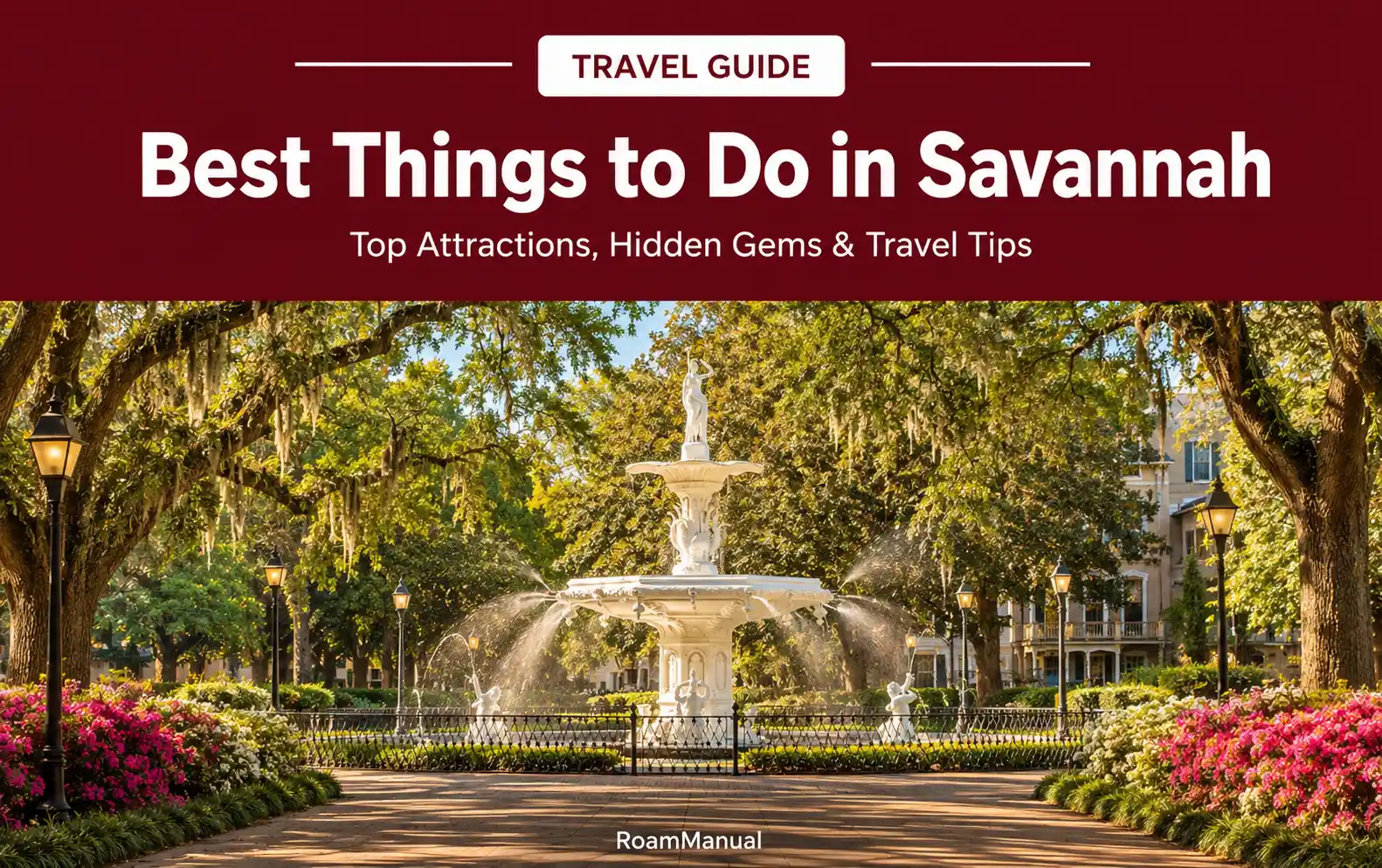
The best things to do in Savannah GA for first-time visitors are exploring the Historic District and its squares, visiting Forsyth Park, walking River Street, choosing one historic house or museum, and taking either a walking or trolley tour.
If you have two or more days, consider Bonaventure Cemetery, Starland District, Wormsloe State Historic Site, Fort Pulaski, or Tybee Island.
For help shaping your schedule, use our guide to 2-day Savannah itinerary.
Savannah is best experienced as a collection of neighborhoods, public squares, historic sites, museums, riverfront spaces, and carefully chosen tours, not as a checklist of isolated attractions. If this is your first visit, our Savannah travel guide for first-time visitors covers the main decisions to make before you arrive.
For a first visit, prioritize a walk through the Historic District and its squares, time in Forsyth Park, the Savannah riverfront, one historic house or museum, and one tour suited to your interests. With an extra day, add Bonaventure Cemetery, Starland, Wormsloe, Fort Pulaski, or Tybee Island.
The key is to choose fewer experiences and leave enough time to enjoy Savannah’s shaded streets, architecture, food, and public spaces. Trying to visit every popular attraction usually creates a rushed trip.
Best Things to Do in Savannah GA Planner
Use this planner to identify which experiences fit your schedule, interests, and transportation plans.
| Experience | Best for | Suggested time | Cost level | Car needed? | Reserve ahead? |
|---|---|---|---|---|---|
| Historic District and squares | First-time visitors | 2–4 hours | Free | No | No |
| Forsyth Park | Walking, families, atmosphere | 45–90 minutes | Free | No | No |
| River Street and Factors Walk | River views, shops, evening activity | 1–2 hours | Free to moderate | No | No |
| Historic house or museum | History, art, architecture | 1–2 hours | Moderate | No | Often helpful |
| Walking tour | Detailed history and local context | 1.5–2 hours | Moderate | No | Recommended |
| Trolley tour | Orientation and easier sightseeing | 1.5–2 hours | Moderate | No | Helpful |
| Bonaventure Cemetery | History, sculpture, landscapes | 1–2 hours | Low to moderate | Usually | Tour only |
| Starland District | Food, art, modern Savannah | 2–3 hours | Moderate | Helpful | Usually not |
| Wormsloe | Live oaks and colonial history | 1.5–2.5 hours | Moderate | Yes | Check before visiting |
| Fort Pulaski | Military history and outdoor time | 2–3 hours | Moderate | Yes | Usually not |
| Tybee Island | Beach time | Half or full day | Moderate | Usually | Seasonal activities |
Times are planning estimates rather than official visit lengths. Check current admission, tour, and reservation details before arrival.
Start With Savannah’s Historic District and Squares
Most first-time visitors should begin here because the Historic District combines Savannah’s famous squares, historic architecture, churches, museums, restaurants, and walkable streets in one compact area.
Savannah’s Historic District is the best starting point because it contains many of the city’s most recognizable sights within a relatively compact area. You can move between tree-shaded squares, churches, monuments, museums, historic homes, shops, and restaurants without driving from attraction to attraction.
Walk through Savannah’s historic squares
Do not approach the squares as a challenge to visit all of them. For most travelers, a route through five or six well-positioned squares provides a better experience than rushing across the entire district.
- Chippewa Square is one of the most recognizable, while Johnson, Wright, Madison, Columbia, and Monterey squares can be combined with churches, historic homes, and residential streets. The best route depends on which museum, restaurant, or tour you already plan to visit.
- Allow at least two hours for an unhurried walk. Three or four hours is more realistic when you include photographs, a church visit, a museum, shopping, or a meal.
- Savannah’s shade makes walking pleasant during many parts of the year, but it does not remove the effects of summer heat and humidity. Plan outdoor sightseeing earlier in the day during hotter months, carry water, and expect uneven sidewalks and street crossings.
Accessibility and walking considerations
Most of Savannah’s Historic District is easy to explore on foot, but visitors should expect uneven brick sidewalks, cobblestones in some areas, and longer walking distances than they may first anticipate.
Travelers with limited mobility may find it helpful to combine walking with a trolley tour or rideshare rather than trying to see the entire district in one outing.
See the Cathedral Basilica of St. John the Baptist
The Cathedral Basilica of St. John the Baptist is an easy cultural stop during a Historic District walk. Its twin spires, stained glass, and detailed interior provide a visual contrast to Savannah’s residential architecture and public squares.
You do not need to build an entire morning around the cathedral. Most visitors can include it naturally while walking between Lafayette Square, Colonial Park Cemetery, and nearby historic streets.
Remember that it remains an active place of worship. Services, ceremonies, or private events may affect visitor access, so check current information and enter quietly.
Walk Jones Street and nearby residential blocks
Jones Street is often promoted as one of Savannah’s most beautiful streets, but its appeal comes from the wider residential setting rather than a single landmark. Brick sidewalks, stoops, trees, historic façades, and small gardens make it a worthwhile part of a walking route.
- Treat the street as a lived-in neighborhood. Keep voices low near homes, avoid blocking entrances for photographs, and do not step onto private property.
- Jones Street pairs well with Monterey Square, Madison Square, Forsyth Park, or a historic-house visit. It is most rewarding when you slow down rather than treating it as a quick photo stop.
Spend Time in Forsyth Park and the Victorian District
Forsyth Park is one of the best free places to slow down, enjoy Savannah’s atmosphere, and take a break between museums, tours, and historic streets.
Forsyth Park provides a welcome change of pace after the denser streets of the Historic District. The park includes walking paths, open lawns, playgrounds, sports areas, shaded seating, and the well-known fountain.
See the Forsyth Park fountain and shaded paths
The fountain is the park’s best-known feature, but it should not be the only reason to visit. Forsyth Park is most enjoyable as a place to pause, walk beneath the trees, watch local life, or take a break between more structured activities.
- Allow 45 minutes for a short walk and photographs.
- Set aside 60–90 minutes when traveling with children, visiting a market, having a picnic, or exploring the surrounding streets.
Best time to visit Forsyth Park
Early morning is usually the most comfortable time to visit Forsyth Park, especially during spring and summer. Late afternoon also offers pleasant light for photography, while weekends often bring markets, community events, and larger crowds.
Forsyth Park works especially well for:
- Families who need open space between museums or tours
- Couples looking for a relaxed walk
- Travelers who enjoy photography and architecture
- Visitors seeking a free activity
- Anyone who wants a break from shops and ticketed attractions
On a one-day visit, combine Forsyth Park with a northbound or southbound walk through the Historic District. There is rarely a reason to drive between the park and the central squares unless mobility, weather, or time makes walking difficult.
Continue into the Victorian District
The streets around and south of Forsyth Park introduce a different architectural character from the older northern sections of downtown.
- Colorful homes, porches, decorative details, and quieter blocks make the Victorian District a useful extension for travelers who enjoy neighborhood walks.
- It is optional on a very short visit. Travelers with limited time may prefer to turn back toward the central squares after seeing Forsyth Park.
- Those with two or more days can continue south or connect the walk with Starland later in the trip.
Choose Forsyth Park when you want shade, open space, a family-friendly break, or a slower view of Savannah.
Shorten the visit when you have only one day and museums, tours, or historic sites are your main priorities.
Explore River Street, Factors Walk, and City Market
River Street is worth visiting for river views, historic warehouse buildings, restaurants, shops, and evening atmosphere, but it should be combined with quieter areas of Savannah rather than treated as the entire destination.
For more ideas that fit this part of your trip, see our guide to hidden gems in Savannah.
Savannah’s riverfront is lively, scenic, and more commercial than the quiet residential squares. River Street occupies former waterfront warehouse buildings and now contains shops, galleries, restaurants, pubs, and places to watch ships move along the Savannah River.
Walk the Savannah riverfront
River Street works best as a one- or two-hour experience. Walk beside the river, watch passing ships, browse selected shops, and stop for a drink or meal when the location suits your schedule.
The area becomes more energetic during evenings and weekends. Travelers looking for nightlife, casual dining, souvenirs, or river views may enjoy that atmosphere. Those seeking quiet streets and architectural detail may prefer an earlier visit.
Best time to visit River Street
Morning offers quieter streets and cooler temperatures, making it easier to explore the waterfront and nearby shops. Evenings provide a livelier atmosphere with restaurants, bars, and entertainment, although weekends can become noticeably busier.
The cobbled surfaces, grade changes, stairs, and ramps can be challenging for some travelers. Visitors with mobility needs should review current accessibility information before arriving.
Look above River Street at Factors Walk
Many visitors remain at river level and miss Factors Walk, the network of elevated streets, bridges, ramps, and former commercial buildings directly above it.
- The area reflects Savannah’s historic role as a port and trading city. Its unusual levels help explain why the riverfront looks and functions differently from the public squares farther inland.
- Factors Walk does not require a separate itinerary block. Include it while moving between River Street and the upper Historic District. Watch for uneven paving, vehicle entrances, railings, and sudden level changes.
Decide whether City Market belongs in your itinerary
City Market is a pedestrian-oriented area with restaurants, shops, galleries, nightlife, and public activity. It can be convenient for a casual meal, live entertainment, or a short break between sightseeing stops.
- It is not an essential half-day attraction for every traveler. Visitors who prefer quieter streets, independent shops, or contemporary neighborhoods may spend less time here and more time around the squares or in Starland.
- City Market pairs naturally with River Street, Franklin Square, Ellis Square, and the western side of the Historic District. A brief walk-through may be enough during a one-day trip.
Consider a Savannah River cruise
A river cruise provides a structured way to see the waterfront and surrounding industrial and port landscape from the water. Options may include sightseeing, meals, entertainment, or evening departures.
- The main trade-off is time. A ticketed cruise fixes part of your schedule, while a riverfront walk remains flexible and free. A cruise makes the most sense for travelers who enjoy being on the water, want a seated activity, or have already allowed enough time for the Historic District.
- For help shaping your schedule, use our guide to best day trips from Savannah.
- On a short first visit, do not book a cruise only because it appears on every attractions list. Choose it because the experience itself fits your interests.
Visit One Historic House or Museum
Savannah has enough historic homes, art museums, and cultural institutions to fill several days. Your best choice depends on whether you care most about architecture, art, social history, decorative interiors, contemporary culture, or popular literature and film.
Owens-Thomas House & Slave Quarters
The Owens-Thomas House & Slave Quarters is one of the strongest choices for visitors seeking architectural and historical context. Its interpretation examines the art and design of the property while addressing the lives and labor of the enslaved people who lived and worked there.
This is not simply a tour of elegant rooms. The site places wealth, urban slavery, domestic labor, and daily life within the same historical story.
Best for: Architecture, social history, and travelers who want a more complete interpretation of historic Savannah.
Main trade-off: A timed tour gives the visit less flexibility than a self-guided museum.
Telfair Academy and the Jepson Center
Choose Telfair Academy when you prefer traditional art, historic interiors, and a building with its own architectural character.
Choose the Jepson Center when you prefer contemporary art, modern architecture, family-oriented art activities, or a flexible indoor stop.
Both can work well during rain, high afternoon temperatures, or a museum-focused day.
Mercer-Williams House Museum
The Mercer-Williams House appeals to visitors interested in architecture, decorative interiors, preservation, and Savannah’s connection to Midnight in the Garden of Good and Evil.
It may be the best choice for travelers who are strongly interested in the book, film, or the home’s design. Visitors seeking a broader interpretation of urban slavery and social history may find the Owens-Thomas House more aligned with their interests.
SCAD Museum of Art
The SCAD Museum of Art offers a contemporary alternative to Savannah’s traditional house museums. It suits travelers interested in art, design, fashion, photography, architecture, and the city’s modern creative identity.
Consider pairing it with Starland or another contemporary cultural stop rather than grouping every museum into one long day.
Pin Point Heritage Museum
Pin Point Heritage Museum presents Gullah Geechee history through the story of the Pin Point community and its connection to coastal work, culture, and community life.
It offers a different perspective from downtown architecture and should not be treated as simply another historic house. Because it lies outside the central sightseeing area, it requires more planning and usually transportation.
Choose Pin Point when cultural history and local community stories are a major trip priority. On a one-day visit, it may be difficult to include without giving up central Savannah experiences.
Which Savannah museum or historic site should you choose?
| Site | Best for | Main strength | Suggested time | Main trade-off |
|---|---|---|---|---|
| Owens-Thomas House & Slave Quarters | Architecture and social history | Layered interpretation of urban life and slavery | 1–1.5 hours | Timed tour |
| Telfair Academy | Traditional art | Historic setting and established collection | 1–1.5 hours | Less focused on wider city history |
| Jepson Center | Contemporary art and families | Modern exhibitions and activities | 1–1.5 hours | Not a historic-house experience |
| Mercer-Williams House | Interiors and popular culture | Recognizable architecture and literary connection | About 1 hour | Tour access is structured |
| SCAD Museum of Art | Art and design | Contemporary exhibitions and adaptive architecture | 1–2 hours | Outside the most compact sightseeing loop |
| Pin Point Heritage Museum | Gullah Geechee heritage | Community-centered coastal history | 1.5–2 hours plus travel | Transportation needed |
Choose the Right Savannah Tour
Walking tours are best for travelers who want detailed history, while trolley tours suit visitors looking for an easier overview with less walking.
A guided tour can help you understand Savannah far better than walking past landmarks on your own. The best choice depends on how you like to travel, how much walking you are comfortable with, and whether you are more interested in history, food, architecture, or entertainment.
Rather than booking multiple tours, most first-time visitors will get the most value from choosing one experience that matches their interests.
Walking tours
Walking tours offer the deepest introduction to Savannah’s history, architecture, and neighborhoods. Because groups are often smaller, guides have more opportunities to answer questions and explain details that are easy to miss while exploring independently.
The main drawback is weather. Summer heat, humidity, and uneven sidewalks can make longer walks tiring, especially during the afternoon.
Trolley tours
Trolley tours provide an excellent overview of Savannah without requiring long periods of walking. They are particularly useful for one-day visitors, older travelers, people with limited mobility, and anyone trying to understand the city before exploring independently.
The trade-off is that trolley tours usually provide less historical depth than dedicated walking tours.
Food tours
Food tours combine local restaurants with stories about Savannah’s culture, neighborhoods, and history. They can work especially well for couples, small groups, food-focused travelers, and repeat visitors.
For meal planning and local food ideas, see our guide to best restaurants in Savannah.
Because they follow fixed schedules and may have limited capacity, consider booking ahead during busy travel periods.
Ghost tours
Ghost tours are one of Savannah’s most recognizable evening experiences. Most combine local legends, historic events, architecture, storytelling, and entertainment.
Different companies use very different styles. Some focus on historical storytelling, while others lean toward theatrical performances. Read descriptions carefully before booking.
Cemetery tours
Guided cemetery tours provide historical context that many visitors would otherwise miss. They are especially worthwhile for travelers interested in local history, Victorian sculpture, famous residents, and landscape architecture.
Walking tour vs. trolley tour
| Feature | Walking tour | Trolley tour |
|---|---|---|
| Best for | History lovers | First-time visitors |
| Walking required | High | Low |
| Historical detail | Excellent | Good |
| Weather exposure | High | Lower |
| Overall pace | Slower and more detailed | Faster and broader |
Visit Bonaventure Cemetery Respectfully
Bonaventure Cemetery is worth visiting if you enjoy history, sculpture, landscape design, and photography, especially on trips lasting two or more days.
Bonaventure Cemetery is one of Savannah’s most famous attractions, but it is very different from a typical tourist site.
People visit for:
- Historic monuments
- Moss-covered live oaks
- Sculpture
- Photography
- Stories of notable Savannah residents
Although beautiful, Bonaventure remains an active cemetery.
Visitors should:
- Stay on established paths
- Keep voices low
- Avoid climbing on monuments
- Respect funeral services and private visitors
Allow approximately one to two hours. Because Bonaventure sits outside downtown, most visitors will need a car, rideshare, or organized tour.
Accessibility considerations
Most of Bonaventure Cemetery is relatively easy to explore, but visitors should expect paved roads, grassy sections, and uneven walking surfaces.
Comfortable shoes, water, and sun protection are especially important during warmer months because shade can be limited in some areas.
Bonaventure is a strong choice for travelers with at least two days, a serious interest in history, or a desire to experience Savannah beyond the central district. On a one-day trip, downtown usually offers better overall value.
Explore Savannah Beyond the Historic District
Travelers with two or more days should consider adding Starland, Plant Riverside, Thunderbolt, or Isle of Hope for a broader view of Savannah beyond its best-known historic streets.
For help shaping your schedule, use our guide to weekend in Savannah.
Discover the Starland District
Starland represents Savannah’s modern creative side. Unlike the Historic District, it is defined less by preserved landmarks and more by independent restaurants, coffee shops, local boutiques, breweries, art studios, and creative businesses.
It is an excellent place to spend an afternoon after you have already explored downtown.
Starland particularly suits:
- Younger travelers
- Food lovers
- Repeat visitors
- Couples
- Travelers looking beyond postcard Savannah
Visit the Plant Riverside District
Plant Riverside combines restaurants, entertainment, hotels, river views, shopping, and public gathering spaces.
Visit around sunset, dinner, or evening entertainment. If your schedule is limited, treat it as an extension of River Street rather than a completely separate attraction.
Thunderbolt and Isle of Hope
Travelers with additional time may enjoy these quieter waterfront areas for marinas, seafood restaurants, residential scenery, and a slower local atmosphere.
They are especially easy to combine with Bonaventure Cemetery or Wormsloe.
Is Wormsloe State Historic Site Worth Visiting?
Wormsloe is most worthwhile for travelers with extra time who enjoy scenic landscapes, photography, and colonial history. It is less essential during a one-day Savannah visit.
Few places near Savannah are photographed as often as Wormsloe’s famous oak avenue. However, many first-time visitors misunderstand what the attraction actually includes.
For more ideas that fit this part of your trip, see our guide to best places to visit in Savannah.
Beyond the entrance avenue, visitors may find:
- Colonial history
- Walking trails
- Museum exhibits
- Archaeological remains
- Natural scenery
Wormsloe is not simply a photo stop.
Who should visit?
Wormsloe is an excellent choice for history enthusiasts, photographers, nature lovers, and travelers spending three or more days in Savannah.
Best time to visit
Morning and late afternoon usually provide the most comfortable temperatures and the best lighting for photography beneath the oak avenue.
Who may skip it?
If you are visiting Savannah for only one day, your time is usually better spent exploring the Historic District.
Because Wormsloe requires transportation and additional travel time, it fits best into longer itineraries.
Add Fort Pulaski or Tybee Island With Extra Time
Fort Pulaski and Tybee Island work best as a half-day or full-day excursion once you have already explored central Savannah.
Fort Pulaski National Monument
Fort Pulaski combines Civil War history, coastal scenery, walking trails, demonstrations, and historic fortifications.
Families and history enthusiasts often find it especially rewarding. Because much of the visit takes place outdoors, weather can influence the experience.
Tybee Island
Tybee Island offers something completely different from Savannah’s historic streets. Instead of museums and architecture, expect beaches, fishing, waterfront restaurants, dolphin tours, and a relaxed coastal atmosphere.
When Tybee Island is the better choice
Choose Tybee Island if your trip includes dedicated beach time or you want a slower coastal day. If you are visiting Savannah for only one or two days, it is usually better to spend most of your time exploring the Historic District before heading to the coast.
Should you combine Fort Pulaski and Tybee Island?
Yes, especially if you have a car and a full excursion day. Their locations make them practical to combine.
Travelers spending only one or two days in Savannah should avoid sacrificing too much downtown sightseeing for coastal activities.
Free Things to Do in Savannah
The best free things to do in Savannah are walking through the Historic District, visiting Forsyth Park, exploring the public squares, walking River Street, and admiring the city’s architecture and monuments.
Some of the best free experiences include:
- Walking through the Historic District
- Visiting Forsyth Park
- Exploring Savannah’s public squares
- Walking River Street
- Seeing Factors Walk
- Browsing City Market
- Admiring historic architecture
- Visiting public monuments
- Watching ships along the Savannah River
These activities provide an excellent introduction to the city without requiring admission tickets. To explore more, read our detailed guide on free things to do in Savannah, GA.
Things to Do in Savannah With Kids
Families should mix outdoor spaces with one or two interactive attractions rather than scheduling several museums or long tours in the same day.
For more ideas that fit this part of your trip, see our guide to things to do in Savannah with kids.
Family favorites include:
- Forsyth Park
- Savannah Children’s Museum
- Georgia State Railroad Museum
- River Street
- Trolley tours
- Fort Pulaski
- Tybee Island
Children usually enjoy shorter sightseeing sessions with regular breaks. Historic streets, warm weather, and uneven sidewalks can become tiring faster than many parents expect.
Families traveling during summer should prioritize:
- Early morning sightseeing
- Indoor museums during the afternoon
- Plenty of water
- Comfortable walking shoes
- Frequent rest stops
Best Things to Do in Savannah for Different Travelers
Best for first-time visitors
- Historic District and squares
- Forsyth Park
- River Street
- One museum or historic house
- One walking or trolley tour
Best for couples
- Evening walks through the Historic District
- Food tours
- Ghost tours
- Forsyth Park
- Riverfront dining
- Rooftop views
Best for history lovers
- Owens-Thomas House & Slave Quarters
- Telfair Academy
- Bonaventure Cemetery
- Fort Pulaski National Monument
- Pin Point Heritage Museum
- Historic walking tours
Best for travelers without a car
- Historic District
- Savannah squares
- Forsyth Park
- River Street
- City Market
- Downtown museums
- Walking and trolley tours
Best for repeat visitors
- Starland District
- Pin Point Heritage Museum
- Local art galleries
- Seasonal festivals
- Specialty food tours
- Neighborhood restaurants
Best for rainy or extremely hot days
- Telfair Academy
- Jepson Center
- SCAD Museum of Art
- Owens-Thomas House
- Local cafés
- Trolley tours
- Food tours
How to Plan Savannah Activities by Trip Length
One day is enough for Savannah’s highlights, two days creates a more relaxed city experience, and three days allows time for attractions such as Wormsloe, Fort Pulaski, Pin Point, or Tybee Island.
If you only have one day
Morning
- Historic District
- Several public squares
- Cathedral Basilica of St. John the Baptist
Afternoon
- Lunch downtown
- Forsyth Park
- One historic house or museum
Evening
- River Street
- Dinner
- Optional ghost or trolley tour
This itinerary focuses on Savannah’s most recognizable experiences while minimizing travel time between attractions, making it the best option for visitors with limited time.
If you have two days
Day One
- Historic District
- Squares
- Museum
- River Street
- Evening tour
Day Two
- Forsyth Park
- Starland District
- Bonaventure Cemetery
- Additional museum or food tour
If you have three days
With three days, add one larger excursion:
- Wormsloe State Historic Site
- Fort Pulaski National Monument
- Tybee Island
- Pin Point Heritage Museum
Avoid trying to visit every major attraction simply because you have additional time. Savannah is best experienced through neighborhoods, restaurants, public spaces, and slower exploration.
Activity planning by available time
| Time available | Recommended priorities |
|---|---|
| One day | Historic District, Forsyth Park, River Street, one museum or tour |
| Two days | Add Bonaventure Cemetery or Starland District |
| Three days | Include Wormsloe, Fort Pulaski, Tybee Island, or Pin Point |
| Four or more days | Explore neighborhoods, specialty museums, local restaurants, and coastal communities |
Practical Tips for Choosing What to Do
Group nearby attractions together
Good combinations include:
- Historic District + Cathedral + squares
- River Street + Factors Walk + City Market
- Forsyth Park + Victorian District
- Starland + SCAD Museum of Art
- Bonaventure Cemetery + Thunderbolt
- Wormsloe + Isle of Hope
- Fort Pulaski + Tybee Island
Do not overbook guided tours
Many visitors underestimate how much walking they already do in Savannah. One excellent tour often provides a better experience than trying to fit two or three into the same day.
Plan around the weather
During warmer months:
- Walk early
- Visit museums during the afternoon
- Drink plenty of water
- Wear comfortable walking shoes
- Expect high humidity
Decide whether you really need a car
Downtown Savannah is highly walkable. A rental car becomes more useful if your itinerary includes Bonaventure Cemetery, Wormsloe, Pin Point Heritage Museum, Fort Pulaski, or Tybee Island.
Otherwise, many visitors find walking, rideshare services, or organized tours sufficient.
Reserve only what requires advance booking
Most public spaces can be visited spontaneously. Consider booking ahead for:
- Historic-house tours with limited capacity
- Popular food tours
- Small-group specialty tours
- Seasonal cruises
Leave room for spontaneous discoveries
Some of Savannah’s most memorable experiences are not major attractions. Quiet residential streets, hidden courtyards, neighborhood cafés, independent bookstores, and shaded public squares often become travelers’ favorite memories.
Avoid scheduling every hour so you have time to explore beyond your itinerary.
Savannah activity planning checklist
- Decide how many days you will spend in Savannah
- Choose one guided tour instead of several
- Reserve timed historic-house tours when needed
- Wear comfortable walking shoes
- Plan outdoor sightseeing during cooler hours
- Decide whether you need a rental car
- Group nearby attractions into the same day
- Leave time for restaurants and relaxed walks
Common Savannah Activity-Planning Mistakes
- Trying to see every attraction
- Underestimating walking distances
- Ignoring Savannah’s summer heat
- Spending too much time driving instead of exploring downtown
- Booking multiple long tours on the same day
- Assuming River Street represents the entire city
- Visiting Wormsloe or Tybee on a one-day trip before exploring the Historic District
- Wearing uncomfortable shoes on brick sidewalks and cobblestones
- Choosing attractions only because they are famous
- Leaving no time for restaurants, cafés, or Savannah’s atmosphere
The most memorable Savannah trips usually include fewer attractions, more walking, and time to appreciate the city’s unique character.
Savannah Planning at a Glance
| If you… | Best choice |
|---|---|
| Are visiting for the first time | Historic District, Forsyth Park, River Street, one museum, one tour |
| Have only one day | Stay within central Savannah |
| Have two days | Add Bonaventure Cemetery or Starland |
| Have three days | Include Wormsloe, Fort Pulaski, Pin Point, or Tybee |
| Prefer history | Historic houses, museums, walking tour, Bonaventure |
| Prefer a relaxed pace | Forsyth Park, River Street, cafés, scenic walks |
| Are traveling with kids | Forsyth Park, children’s attractions, Fort Pulaski, Tybee |
| Do not have a car | Focus on the Historic District and downtown attractions |
Frequently Asked Questions
What are the best things to do in Savannah GA for first-time visitors?
Start with the Historic District, Savannah’s public squares, Forsyth Park, River Street, one historic house or museum, and either a walking or trolley tour.
How many days should you spend in Savannah?
Two days allow you to experience the city’s major attractions comfortably. Three days make it easier to include an excursion such as Wormsloe, Fort Pulaski, Pin Point, or Tybee Island.
Can you explore Savannah without a car?
Yes. Most attractions within the Historic District are easily reached on foot. Transportation becomes more useful for destinations outside downtown.
What are the best free things to do in Savannah?
Walking through the Historic District, visiting Forsyth Park, exploring River Street, discovering Savannah’s public squares, and enjoying the city’s architecture are among the best free experiences.
Is River Street worth visiting?
Yes. River Street offers river views, restaurants, shopping, and a lively atmosphere. However, it should be combined with other neighborhoods rather than becoming your entire Savannah itinerary.
Is a trolley tour worth it?
For many first-time visitors, yes. A trolley tour provides a useful overview and helps you identify places you may want to revisit on foot.
Is Bonaventure Cemetery worth visiting?
Yes, especially for travelers interested in history, sculpture, and photography. Visitors with only one day should usually prioritize downtown Savannah first.
Is Wormsloe worth visiting?
Yes, if you have at least two or three days or particularly enjoy colonial history and scenic landscapes. It is less essential on a short visit.
Can you visit Tybee Island during the same trip?
Yes. Travelers with three or more days can comfortably combine Savannah with Tybee Island, while shorter trips are usually better spent exploring Savannah itself.
What should you book before arriving?
Historic-house tours, food tours, specialty walking tours, and other small-group experiences often benefit from advance reservations, especially during busy travel periods.
Final Recommendation
Savannah is not a destination that rewards rushing from landmark to landmark.
Its greatest appeal comes from wandering beneath live oaks, discovering quiet public squares, enjoying Southern food, learning the city’s layered history, and slowing down enough to notice the details that make Savannah distinctive.
If you are visiting for the first time, build your trip around the Historic District, Forsyth Park, River Street, one carefully chosen museum or historic house, and a guided tour that matches your interests. Add Bonaventure Cemetery, Starland, Wormsloe, Fort Pulaski, Pin Point, or Tybee Island only when your itinerary allows.
Savannah rewards curiosity more than speed. Instead of measuring your trip by the number of attractions you visit, focus on choosing experiences that match your interests and leave time to enjoy the city’s neighborhoods, parks, restaurants, and historic atmosphere.
A well-paced itinerary almost always creates a richer experience than trying to see everything.
